
The Power of Simulation in Engineering
Learning To Be Strong Simulates
The Evolution of Design
The role of Simulation in assisting engineers to predict the strength, durability and the break-even point.
In classical engineering, physical testing was used to test strength and durability, build, test, fail, and repeat. Although effective, it was reactive, time-consuming and expensive. Simulation has been taken by modern engineering.
Nowadays, software, such as Finite Element Analysis (FEA), can help engineers to determine how a part performs even before it was created.
Virtual Load Testing
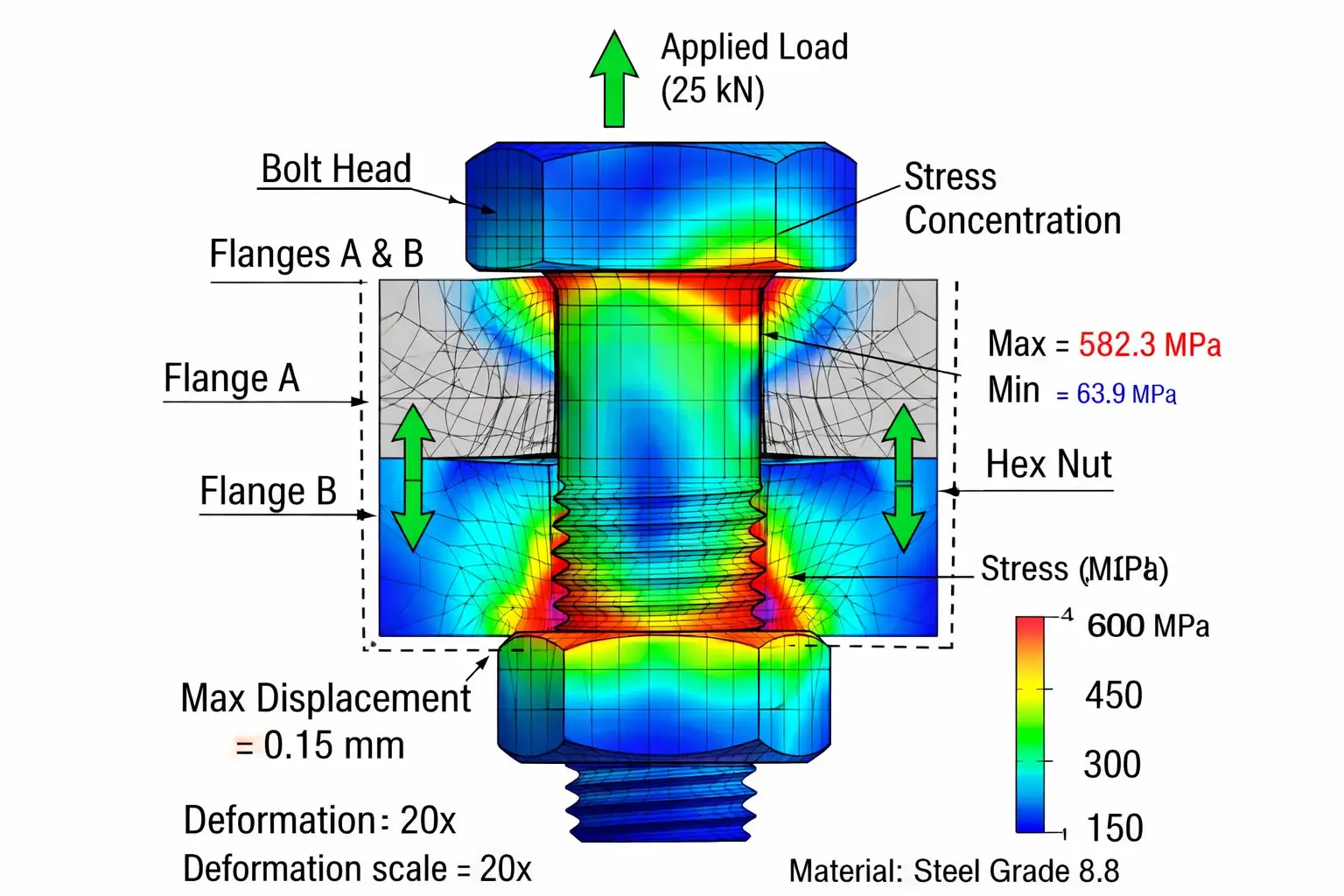
Simulation helps the engineers to test real-life loads in a virtual environment and monitor the behavior of a component. In a conventional bolt and nut system when in tension:
- The distribution of stress is well illustrated.
- Important areas (such as contacts and threads) are located.
- Material limits are compared to maximum stress values.
- Engineers are not guessing but understand where failure can start.
Predicting Durability
Durability is not about sustainability of one load—it is about survival after repeated loading with time.
Simulation helps in Fatigue analysis (endurance of cycles by a part) by:
- Determining the concentration areas of stress that cause cracks.
- Utilizing geometries to minimize wear and tear.
- Ensuring the product does not only work, but remains durable.
Failure Thresholds
In a virtual environment, the applied load can be made to progressively increase to find exact limits:
- Knowing the precise load at which deformation will be critical.
- Predicting the point of material yielding or fracture.
- Defining safety factors with total accuracy.
This is what constitutes the break-even point—the line between safe operation and failure.
Reality Engineering Applications
Unambiguously, simulation brings significant business and engineering benefits:
- Lower prototyping cost - less physical prototyping required.
- Quick product development - optimized design occurs early.
- Better dependability - failures are forecasted rather than found.
- Efficient utilization - materials are never over-designed or under-designed.
Engineering Insight
Simulation is not merely about visualization but about making decisions. It enables engineers to transition away to data-driven design as opposed to assumption-based design.
"Not: Will this work? You begin to enquire: How far can this go in all circumstances?"